The Eclipse and the Economics of Scarcity
Contents
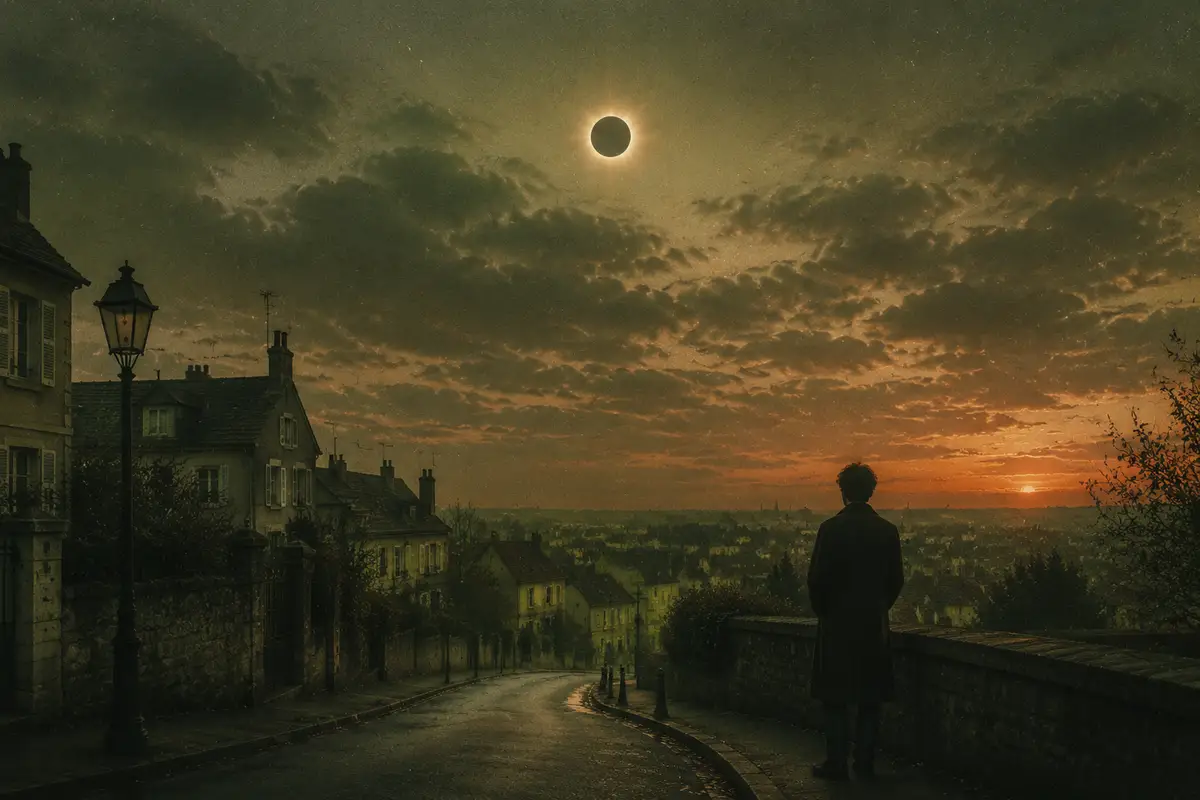
A solar eclipse is, in one sense, an entirely ordinary event. Nothing supernatural happens when the Moon passes between the Earth and the Sun. The eclipse is simply the consequence of familiar physical laws: the motion of the Moon, the rotation of the Earth, and the position of the Sun. The same gravitational relationships that produce an eclipse are operating every day.
And yet, when an eclipse occurs, people stop what they are doing to watch it.
This raises an interesting question: what makes an event extraordinary to us?
The eclipse is not extraordinary because the physical laws governing it suddenly become more remarkable. It is extraordinary because it is rare. The Sun rises every morning, but we barely notice. A total solar eclipse may occur only once in a particular location within a person’s lifetime, and suddenly the same human beings who normally ignore the sky organize trips, buy special glasses, make observations, take photographs, and wait for the precise moment when the Moon covers the Sun.
The difference, therefore, may not lie entirely in the event itself. It may lie in the way human beings respond to scarcity.
Rarity and Value
An eclipse illustrates a distinction that is easy to overlook: rarity and value are not the same thing.
Something can be rare without being particularly useful, and something can be abundant without being unimportant. The daily rising of the Sun is vastly more consequential to human life than a solar eclipse, yet its frequency makes it psychologically ordinary. The eclipse, by contrast, derives much of its salience from the fact that it does not happen very often.
This suggests that scarcity can function as a mechanism of attention.
Human beings are naturally sensitive to deviations from what they expect. Something that happens every day becomes part of the background. Something that happens once in a decade becomes an event. Rarity makes an occurrence salient, and salience can become the basis for desire, curiosity, prestige, and eventually value.
This mechanism has obvious parallels in economics.
A product that is available everywhere and at any time tends to become ordinary. A product that is difficult to obtain, available only in limited quantities, or accessible only to a small group can acquire a different psychological status. The object itself may not have changed. What has changed is its availability.
A limited-edition object, for example, may be physically almost indistinguishable from an ordinary version of the same object. Yet once consumers know that only a hundred exist, the object can become much more desirable. Scarcity creates attention; attention creates desire; desire can create competition; and competition can produce price.
In this sense, scarcity does not merely describe an economic condition. It can also become a psychological force.
From Natural Scarcity to Artificial Scarcity
Not all scarcity is of the same kind.
Some forms of scarcity arise from physical limitations. A particular piece of land cannot occupy two locations simultaneously. A specific seat in a room can accommodate one person at a given moment. A particular amount of time cannot simply be reproduced. These constraints exist independently of whether people perceive them as valuable.
But many forms of scarcity in modern economies are institutional rather than purely physical.
Consider a digital file. Once a song, photograph, book, or piece of software exists in digital form, making another copy can be almost costless. The information itself does not become materially depleted when another person accesses it. Unlike a physical object, one person’s possession of the file does not necessarily prevent another person from possessing an identical copy.
Yet intellectual-property systems can make access to that information exclusive. Copyright and related institutions create rights that restrict who may reproduce, distribute, or commercially exploit the work.
In such cases, what is scarce is not necessarily the information itself. What is scarce is the legally recognized right to control its use.
This is an important distinction because it shows that economic scarcity does not always correspond directly to physical scarcity. Human institutions can create forms of exclusivity around things that are otherwise highly reproducible.
The same principle appears in limited editions, licenses, quotas, exclusive memberships, and other systems in which access is deliberately restricted. The scarcity may be real once the institution establishes the restriction, but it is not necessarily a consequence of nature.
Sometimes, in other words, scarcity is produced rather than discovered.
When Scarcity Becomes the Product
The most interesting cases occur when scarcity itself becomes part of what is being sold.
Luxury goods provide an obvious example. A watch that costs thousands of dollars does not merely sell the practical function of telling time. Much of its value may come from craftsmanship, history, brand identity, status, and exclusivity. The fact that relatively few people possess it can itself become part of the reason people want it.
The same principle appears in collectibles, rare artworks, exclusive memberships, prestigious institutions, and limited-access experiences.
Here scarcity is not merely a constraint surrounding the good. Scarcity becomes part of the good’s meaning.
This leads to the idea of positional value. Some goods are valuable partly because relatively few people can possess them. If everyone possessed the same status, distinction, or exclusivity, the value associated with that position could disappear.
A world in which everyone owns a “limited edition” object illustrates the paradox perfectly: once everyone has it, its scarcity—and therefore part of its appeal—has vanished.
The economic system can therefore operate not only by allocating scarce resources, but also by responding to and sometimes deliberately producing forms of scarcity that humans find psychologically compelling.
The Eclipse as a Metaphor
The eclipse provides a useful metaphor because it separates the object from the response to the object.
The Sun has not become more important during an eclipse.
The Moon has not suddenly acquired more physical significance.
Gravity has not changed.
What changes is the frequency with which we encounter that particular configuration.
The eclipse is rare, and its rarity changes our attention.
This is precisely why the eclipse can serve as a metaphor for economic scarcity. It suggests that part of what we call “value” may arise not from an intrinsic transformation in the object, but from a transformation in our relationship to its availability.
If the sky produced a total solar eclipse every morning, we would probably stop organizing our lives around it. The eclipse would become another part of the background, much like sunrise.
Conversely, if sunrise occurred only once every ten years, humanity would probably regard each sunrise as an extraordinary event.
The physical phenomenon would be the same. Our valuation of it would not be.
This reveals something important: human beings do not respond only to what things are; they respond to how frequently, exclusively, and unexpectedly they encounter them.
Scarcity, Attention, and Economic Value
This does not mean that all economic value is an illusion created by scarcity.
Resources can be genuinely limited, and scarcity creates real problems of allocation. Food, land, time, energy, and labor cannot simply be multiplied without consequence. Economics exists in part because human wants exceed the resources available to satisfy them.
But scarcity alone does not explain everything we value.
Human beings also possess psychological mechanisms that make rarity salient. We notice what is unusual. We compete for what is difficult to obtain. We sometimes desire things precisely because other people cannot easily have them.
Thus economic value can emerge from an interaction between material scarcity, institutional scarcity, and psychological responses to scarcity.
The first concerns the limits of the physical world. The second concerns the rules through which societies allocate access. The third concerns the human mind’s response to limited availability.
These forms of scarcity can reinforce one another.
A physically scarce resource can become socially prestigious. A socially restricted resource can become psychologically desirable. A psychologically desirable resource can become economically valuable. And once something becomes valuable, institutions may have incentives to preserve or even intensify its scarcity.
The result is a feedback loop:
scarcity creates attention; attention creates desire; desire creates competition; competition creates value; and value creates incentives to preserve scarcity.
The Deeper Question
The eclipse ultimately raises a question that extends beyond economics:
Is value a property of things, or is it a relationship between things and human beings?
The Sun does not become more valuable because an eclipse is occurring. The physical world does not announce that the eclipse is worth watching. The value arises through human perception, expectation, curiosity, culture, and meaning.
Economics, in turn, formalizes some of these human responses through prices, markets, property rights, and exchange.
Perhaps this is why scarcity has such extraordinary power. Scarcity is not merely about there being less of something. It changes the way we look at what exists.
The everyday becomes invisible through abundance. The rare becomes visible through absence.
A sunrise happens constantly, and therefore becomes background.
An eclipse happens rarely, and therefore becomes an event.
The economic world is filled with analogous transformations. Some things are valuable because they are genuinely difficult to obtain. Others are valuable because access to them has been restricted. Still others become valuable because their rarity makes them psychologically salient.
The eclipse reminds us that these categories should not be confused.
Rare is not necessarily valuable. Valuable is not necessarily scarce. And scarcity itself can be natural, institutional, or psychological.
What the eclipse reveals, perhaps, is not something about the Sun at all.
It reveals something about us: we do not merely inhabit a world of scarce things; we are creatures who notice, desire, and assign meaning to what we cannot have often, easily, or equally.
And that may be one of the psychological foundations upon which an economy of scarcity becomes possible.