The Two Games
Contents
The journey into the core paradox of human civilization begins with a simple, literal mathematical truth: the zero-sum game. In its purest definition, it describes a closed environment where one participant’s gain is a mirror image of another’s loss. If you sum up the total profits and subtract the total losses, the net result balances perfectly at zero.
This concept finds its perfect physical manifestation in a classic balance scale. The scale sits anchored at a neutral baseline. For one pan to rise into the air, the opposing pan must plunge by the exact same distance. No mass is created, and no mass is destroyed; the system simply redistributes a fixed amount of weight.
In everyday language, however, this strict definition is frequently diluted. People routinely misuse “zero-sum” as a casual synonym for a simple binary choice or a personal trade-off, such as balancing a career against a social life. But this casual usage misses the vital structural requirement of the concept: for a game to be truly zero-sum, the creation of new value must be impossible.
The Physics of Scarcity
To understand the rigid boundaries of a true zero-sum system, we can look to the natural laws of physics. The Law of Conservation of Energy dictates that within an isolated system, energy cannot be created or destroyed, only transferred. A zero-sum game operates under this exact thermodynamic constraint.
This mechanical reality is beautifully illustrated by a closed hydraulic system. Imagine two connected pistons filled with an incompressible fluid. When force is applied to push Piston A downward, Piston B is forced upward by the exact same volume of displaced liquid. The net change in the fluid volume remains zero.
For centuries, human societies viewed the world through this strict hydraulic lens. Early economic theories assumed that wealth was a fixed, physical mass—a pie of a permanent size. Under this logic, the only way for one nation to grow richer was to violently depress the piston of its neighbor, conquering land and seizing gold in a perpetual struggle over a finite pool of resources.
The Alchemy of the Mind
Humanity eventually broke free from this rigid hydraulic trap by discovering a profound truth: economic value is not a fixed physical substance; it is fluid, psychological, and dynamic. It lives entirely within the human mind. Because value is subjective, business is fundamentally a non-zero-sum game.
Through innovation, humans rearrange ordinary raw materials into entirely new configurations that are worth far more than the sum of their parts. Through branding and marketing, we alter human perception, manufacturing genuine psychological utility, status, and satisfaction out of thin air without altering the physical composition of a product. When a consumer voluntarily trades a five-dollar bill for a cup of coffee, value is created on both sides of the transaction; the consumer values the caffeine more than the paper money, and the café values the money more than the beans.
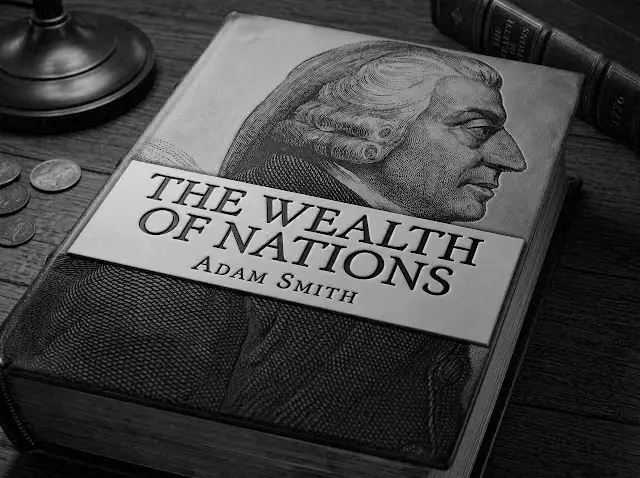
This web of voluntary, self-interested exchanges forms the foundation of Adam Smith’s famous “Invisible Hand.” Smith argued that by allowing individuals to pursue their own self-interest, the market naturally drives innovation and efficiency. The butcher and the baker do not serve us out of charity, but to earn a living. Yet, to succeed, they must create something of value for others. In doing so, they inadvertently expand the total economic pie, transforming society into a cooperative, positive-sum ecosystem where mutual gain is possible.
The Broken Scale
Yet, this triumphant escape from zero-sum limits has triggered a catastrophic collision with a larger, older system. While human business operates on an infinite, psychological positive-sum model, the Earth’s ecosystem remains a strictly finite, physical zero-sum system.
The Earth is an open system for energy—receiving light from the sun and radiating thermal heat back into the cold void of space. For the planet’s temperature to remain stable, the cosmic scale must balance perfectly: energy in must equal energy out. To fuel our positive-sum economic engine, human industries have pulled locked carbon from the ground and pumped it into the atmosphere. This process did not violate the conservation of energy; instead, it altered the Earth’s physical mechanics.
Greenhouse gases act as a one-way thermal blanket, trapping the infrared energy that should have escaped into space. The current warming of the planet is the physical debt of that trapped energy. We have treated a closed, delicate hydraulic loop as an infinite dumping ground, proving that while we can manipulate the human mind to create economic value, we cannot market our way out of the laws of thermodynamics.
The Tightrope and the Treadmill
This tension brings modern civilization to a terrifying realization: we are currently riding a bicycle down a ten-centimeter-wide road, flanked by steep cliffs on either side. The forward momentum of the bicycle represents our growth-addicted economy. If we stop pedaling—if we completely cease creating new value—the system does not simply pause; it faces a systemic death spiral. Our global financial structure is built entirely on credit and the expectation of future growth to pay off past debts with interest. Without growth, credit evaporates, banking networks collapse, and supply chains disintegrate.
Yet, if we pedal the bicycle too fast in search of infinite growth, we plunge off the right cliff into ecological collapse. If we slow down to save the planet, we risk falling off the left cliff into economic ruin.
The Architecture of Anticipation
The reason we cannot easily return to that peaceful, present-tense baseline is that the machinery of our anxiety is hard-wired into our genetic code. While a wild animal experiences fear only in the immediate presence of a predator, the human brain possesses the unique, agonizing superpower of predictive simulation. We do not just experience present pain; we calculate and feel anticipatory pain.
This constant, simulated trauma is the exact evolutionary whip that drove humanity to rule the world. We cleared forests, built brick walls, stockpiled resources, and invented complex financial systems to protect ourselves from the imagined horrors of tomorrow. Compounding this anxiety is the Hedonic Treadmill—an evolutionary design flaw that ensures human satisfaction is always fleeting.
Ultimately, the story of human civilization is the story of this evolutionary adaptation running out of control. We are an anxious species biologically programmed for infinite anticipation, trapped inside a modern economic system that requires infinite growth, trying to survive on a planet governed by rigid, finite mathematics. We have mastered the art of expanding the psychological pie, but in the process, we have lost the ability to simply sit still, look at the fire warming our palms, and live in the world as it is.