Me, AI, and the Em Dash
Contents
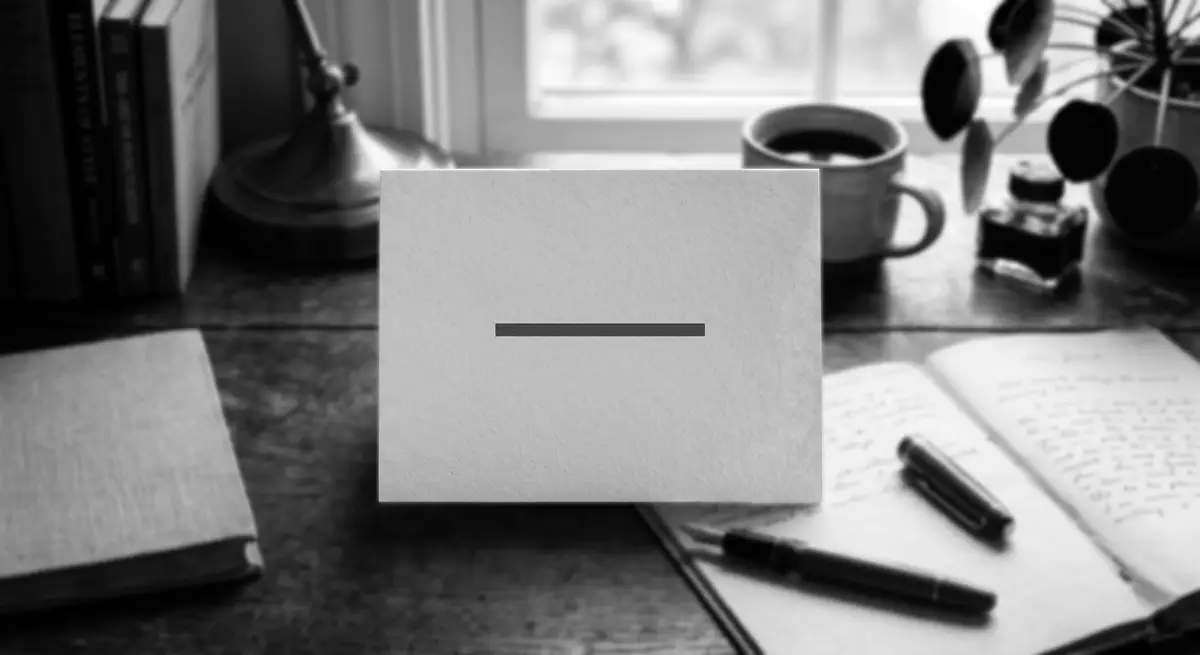
I have always loved the em dash (this symbol: —). To me, the em dash is one of the most useful punctuation marks with a highly specific purpose, and its presence in a piece of writing somehow makes me instinctively place a certain confidence in the author. It’s as though I think to myself, “I think I’m in good hands.”
Let me explain
Are you aware (or is it just me who feels this way?) that we subconsciously categorize certain ways of speaking into hierarchical labels? We instinctively infer a certain level of intellectual sophistication when someone speaks in a particular manner or style. This is one of those judgments we make almost instinctively. But when asked how we know it, we struggle to answer.
“I just know it,” we reply.
In writing, that same quality often takes a different form. The style we might associate, in speech, with a certain level of intellectual sophistication tends—almost inevitably—to make generous use of the em dash (do you see how I just made that point while simultaneously demonstrating it?).
See?
In the realm of writing, that quality suddenly manifests itself in the em dash. This still doesn’t tell us what an “intellectual” way of speaking actually is. It is—at least in my opinion—quite delightful to see that a punctuation mark is able to accommodate such a specific rhetorical purpose and perform it so well. Whether this punctuation mark genuinely signals a certain threshold of intellectual sophistication is a separate question altogether, one that only deepens my fascination with it.
Then came LLMs
Then large language models (LLMs) came along, and people began to notice that these models generated responses containing a remarkable number of em dashes. People gradually started making the association that if a piece of writing contained many em dashes, it was almost certainly AI-generated. To me, that was a rather unsettling conclusion, though not an entirely surprising one.
What I found more interesting, however, was what happened when I held that conclusion alongside my own long-held heuristic.
If I had always believed that the kinds of writers I admired—those whose writing carried a certain intellectual rhythm—also happened to use em dashes more frequently, and if we now collectively observed that LLMs also exhibited the same tendency, then what exactly were we supposed to conclude?
One possibility is that my heuristic was right all along. Perhaps writers who consistently engage with nuanced ideas, qualify their claims, anticipate objections, and weave together multiple threads of thought do, in fact, gravitate toward the em dash. If that is true, then it should hardly be surprising that a language model trained on an enormous corpus of human writing would converge on the same habit. After all, if the model is learning patterns from what we collectively regard as effective writing, then inheriting the em dash may simply be part of the package.
Another possibility is even more intriguing
Perhaps the em dash has very little to do with intelligence itself. Perhaps it is simply what naturally emerges whenever someone attempts to explain something carefully. It occupies a peculiar middle ground: less detached than parentheses, less abrupt than a full stop, and more flexible than a comma. It allows a sentence to briefly step aside—to qualify, clarify, or entertain a parallel thought—before returning almost seamlessly to its original trajectory. It resembles, in a small but surprisingly faithful way, the rhythm of thinking itself.
If that is the case, then neither humans nor language models are deliberately “choosing” the em dash because it sounds intellectual. They are merely arriving at the same solution to the same problem.
That possibility fascinates me.
It suggests that what we often dismiss as a stylistic quirk may actually be a consequence of the kind of writing being attempted. If your goal is to compress complexity into a sentence without sacrificing its flow, perhaps the em dash is simply difficult to avoid. Not because it is fashionable. Not because it is sophisticated. But because it works.
Ironically, this makes the recent suspicion surrounding the em dash feel somewhat misplaced.
People often joke that the em dash has become ChatGPT’s signature punctuation mark. Yet if the observation holds any truth, it may reveal less about AI than it does about us. The model did not invent the habit. It inherited it—or perhaps rediscovered it—from the very writing we have long considered articulate, thoughtful, and worth learning from.
So I still find myself smiling whenever I encounter an em dash.
Not because it tells me the writer is intelligent.
Not because it tells me the writer is human.
But because it reminds me that somewhere beneath all the discussion about AI, prompts, and generated text lies a quieter question about writing itself. Perhaps some stylistic choices are not merely conventions we happen to adopt, but destinations we naturally arrive at when we are trying, as honestly as we can, to think clearly on the page.
And if that is true, then the em dash was never really the story.
It was simply the clue.