Nothing Is Personal, and Nothing Lasts Forever
Contents
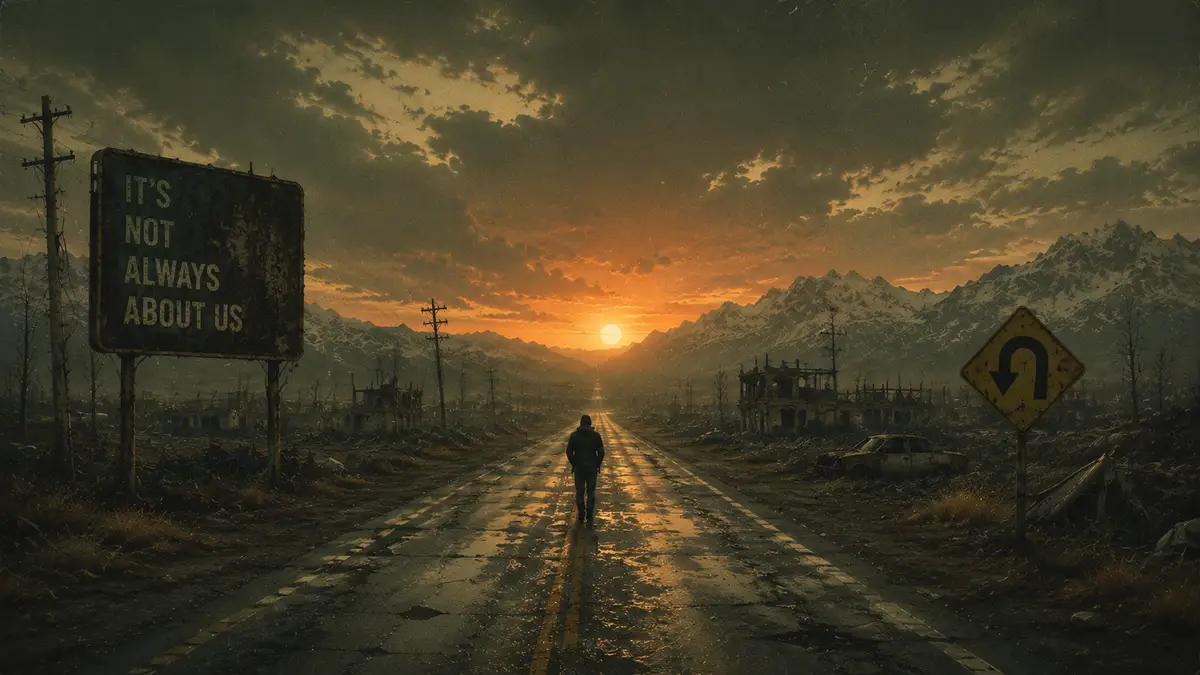
There is a common way of talking about humanity and the natural world that I have increasingly found difficult to accept. It begins with a seemingly obvious distinction: nature is balanced, animals live within that balance, and human beings—through intelligence, technology, industry, and capitalism—have disrupted it. Climate change is then presented as perhaps the clearest evidence that humanity has become a destructive force unlike anything that existed before.
I do not find this framing entirely convincing.
This is not because climate change is unreal, nor because human activity has no ecological consequences. The more fundamental question is different: what exactly do we mean when we say that an ecosystem has been “disturbed,” and why do we assume that the state being disturbed represents some kind of natural equilibrium that ought to exist?
The Earth has never been static. Its climate has changed repeatedly. Species have appeared and disappeared. Oceans, atmospheres, continents, forests, deserts, and food webs have continuously transformed. Long before Homo sapiens existed, life itself had already radically altered the planet. Photosynthetic organisms transformed the atmosphere by producing oxygen; organisms altered soils and waterways; predators reshaped prey populations; plants transformed their environments simply by growing.
The history of life is therefore not the history of a stable planet occasionally disturbed by humans. It is the history of a dynamic system in which organisms continually alter the conditions in which other organisms live.
From this perspective, humanity is not an alien force that arrived from outside nature. Humanity is one of nature’s products.
The Illusion of a Natural Equilibrium
Perhaps the problem begins with the word equilibrium.
We often speak as though nature has a correct configuration toward which it naturally tends. A forest exists, animals inhabit it, plants grow, predators regulate prey, and everything somehow remains in balance—until humans arrive and disrupt the arrangement.
But equilibrium is always relative to a particular scale of observation.
A population may appear stable over ten years while changing dramatically over ten thousand. A forest may look permanent to a human lifetime while being merely a temporary ecological configuration over geological time. A species may dominate an ecosystem for millions of years before disappearing completely.
The closer we zoom in, the more stable the system can appear. The farther we zoom out, the more obvious its transformations become.
There is therefore no obvious reason to regard the ecological state of the Earth at any particular moment as the natural state of the Earth. A forest existing today is not more metaphysically authentic than the ocean that occupied the same location millions of years ago. The dinosaurs were not maintaining the planet in a more legitimate equilibrium than mammals do today. The extinction of a species does not constitute a violation of some cosmic ecological law.
Nature does not appear to contain an external mechanism whose purpose is to preserve any particular configuration of life.
There are only organisms, environments, feedback loops, competition, reproduction, adaptation, and change.
The Intelligence of the Human Animal
This also changes how we should think about human intelligence.
There is a tendency to treat intelligence as something morally elevated. The assumption often runs quietly from intelligence to rationality, from rationality to wisdom, and from wisdom to moral superiority.
But intelligence is fundamentally a capacity.
It gives an organism greater ability to manipulate its environment. It does not determine what that organism ought to do with that ability.
A human being can use intelligence to create mathematics, music, medicine, philosophy, agriculture, nuclear weapons, financial markets, cities, or industrial systems. The intelligence itself does not contain a moral direction.
In this sense, human intelligence may be understood as simply another survival apparatus.
A rodent has teeth with which it can exploit its environment. A bird has wings. A plant has roots, leaves, and chemical defenses. Humans possess extraordinarily sophisticated cognitive capacities.
The difference is enormous in scale and mechanism, but perhaps less profound in principle than we usually imagine.
Consider a hypothetical world in which, instead of Homo sapiens, a species of rodent became extraordinarily successful. Imagine that its population exploded because food was abundant and predators were scarce. The rodents consumed enormous quantities of vegetation. They gnawed through trees, destroyed forests, depleted their food supply, and eventually altered the ecosystem that sustained them.
Would we say that the rodents had committed a moral crime against nature?
Probably not.
They would simply have been rodents behaving as rodents do under those ecological conditions.
Their lack of human-level intelligence would not make their ecological impact morally innocent. Nor would their intelligence be required to explain it.
This suggests that ecological transformation does not fundamentally require intelligence. It requires only organisms interacting with their environment in ways that allow them to survive and reproduce.
Human intelligence merely gives one species an extraordinarily powerful version of this capacity.
Survival Can Destroy the Conditions of Survival
There is an even deeper paradox here.
The very mechanisms that make an organism successful can eventually undermine the conditions of that success.
A population grows because its environment provides abundant resources. Its growth increases resource consumption. Increased consumption alters the environment. The altered environment then reduces the resources available to the population.
The same process can occur at many scales.
A population of herbivores can consume vegetation faster than it regenerates. A plant community can transform its soil. A predator can reduce its prey population. Microorganisms can alter the chemical conditions of their surroundings. Humans can extract enormous quantities of energy and material from the Earth and transform the planetary environment in the process.
This does not require a moral narrative.
It is a feedback system.
In ecological terms, an organism does not merely adapt to an environment. It can also construct and transform its niche, after which the transformed environment feeds back upon the organism.
This makes the relationship between life and environment fundamentally reciprocal.
The environment shapes the organism.
The organism shapes the environment.
The resulting environment shapes the next generation of organisms.
There is no simple division between an innocent nature and an intrusive organism.
Humanity and Capitalism
Capitalism can be understood within this framework without treating it as a uniquely evil force.
Human beings require resources. Throughout history, they developed increasingly effective ways of obtaining them: fire, hunting technologies, agriculture, domestication, trade, states, machines, fossil fuels, industrial production, and global markets.
Capitalism became one of the most powerful systems for organizing production, accumulation, investment, and resource extraction. It greatly amplified humanity’s ability to transform resources into useful goods and services.
But precisely because it was so effective, it also amplified the ecological consequences of human survival and expansion.
This produces a peculiar paradox:
the mechanisms that increase humanity’s capacity to survive can also undermine the environmental conditions upon which that survival depends.
Yet there is nothing uniquely human about the underlying paradox.
The rodent that destroys its food supply and the human civilization that transforms its atmosphere differ enormously in complexity. But both can be understood as cases in which a successful organism modifies the conditions that made its success possible.
Human intelligence makes the feedback extraordinarily sophisticated. It does not necessarily make the underlying biological logic fundamentally different.
The Moralization of Intelligence
This is why I resist assigning moral value to intelligence itself.
Being intelligent does not mean being good.
Being unintelligent does not mean being harmless.
A bacterium does not need a brain to alter its environment. A locust does not need philosophy to devastate vegetation. A beaver does not need an ethical theory to transform a river.
Likewise, humans do not need to possess some uniquely destructive moral character in order to transform the planet.
They simply possess an unusual combination of biological characteristics that makes large-scale environmental modification possible.
The mistake is to confuse capacity with virtue.
Intelligence is not goodness. It is power.
And power can be used in countless directions.
The Other Side of the Moral Equation
There is also something interesting about the human desire to “save nature.”
At first glance, conservation appears to stand in opposition to exploitation. One destroys the environment; the other protects it.
But from another perspective, both can be understood as strategies arising from the same fundamental fact: organisms prefer conditions under which they can continue to exist.
Humans exploit environments because resources sustain human life.
Humans conserve environments because certain environmental conditions sustain forms of life that humans value—including themselves.
This does not make conservation meaningless or hypocritical. It simply means that conservation does not necessarily represent the discovery of some objective commandment issued by nature.
Nature does not demand that a particular forest remain untouched.
Nature does not demand that Homo sapiens survive.
Humans decide that they want certain things to continue existing and construct moral, political, and economic systems around those preferences.
That distinction matters.
To say that humans want to preserve the biosphere is one thing.
To say that the biosphere itself demands to be preserved in its present form is another.
The Absence of a Cosmic Obligation to Survive
This leads to perhaps the most uncomfortable consequence of this worldview.
There is no obvious reason to believe that Homo sapiens has a cosmic obligation to exist forever.
Evolution did not have humanity as its destination. There is no predetermined evolutionary ladder on which humans occupy the final and highest rung. There is no evidence that biological history is moving toward increasing intelligence, increasing complexity, or increasing moral sophistication.
Homo sapiens emerged.
We survived.
We expanded.
We transformed our environment.
And, eventually, we may disappear.
If that happens, it will not necessarily mean that humanity failed to fulfill some cosmic purpose. Extinction is not a moral category. Trilobites did not morally fail by disappearing. Dinosaurs did not betray evolution. Neanderthals did not commit an existential mistake.
They ceased to exist.
There is no reason, from biology alone, to believe that humans must be different.
This does not require hatred of humanity. Quite the opposite. One can value human existence intensely while refusing to regard its continuation as a metaphysical necessity.
One can love something without believing that it must last forever.
Nothing Is Personal
Imagine, then, an extreme thought experiment.
Suppose Homo sapiens is approaching extinction, and there is no possibility of reversing it. Imagine being the last human alive, knowing that after your death there will be no human successor.
Would the extinction of humanity necessarily require a cosmic lament?
Perhaps not.
One could look at the entire history of the species—the struggles, discoveries, wars, friendships, civilizations, mistakes, achievements—and simply recognize that it happened.
Humanity was here.
It lived according to the conditions imposed by its biology, its environment, and its historical circumstances.
It did what organisms do: it tried to persist.
And eventually, perhaps, it would stop.
There would be something almost fitting about accepting that without imagining that the universe had personally wronged us.
Nothing is personal, and nothing lasts forever.
That does not mean that life is worthless. It means that existence does not need to be eternal in order to have existed.
A sunset does not become meaningless because it ends. A song does not fail because it has a final note. A species does not become a mistake because it eventually disappears.
Perhaps Homo sapiens is simply one more temporary configuration produced by the enormous, directionless history of life.
Conclusion
The question, then, may not be whether humanity has “destroyed nature.”
Humanity has certainly transformed its environment, just as every sufficiently successful organism transforms its environment in some way.
The deeper question is whether we should regard one particular ecological configuration as the authentic equilibrium of nature, whether intelligence itself deserves moral status, and whether the survival of a species constitutes an objective good simply because that species happens to be alive.
I am skeptical of all three assumptions.
Nature has no obvious final equilibrium.
Intelligence is a capacity, not a virtue.
And survival is not necessarily a cosmic mandate.
Humans are unusual, but unusual does not mean metaphysically privileged. Our intelligence has allowed us to transform the world on an extraordinary scale, but perhaps that is simply what happens when one particular animal acquires an extraordinary means of exploiting its environment.
Another species might have done something different.
A rodent might have eaten the forests.
A microorganism might have transformed atmospheric chemistry.
A predator might have reshaped an entire food web.
There is no guarantee that any of these scenarios would produce a stable equilibrium. There is no guarantee that evolution would produce Homo sapiens again. There is no guarantee that life itself has any destination.
There is only change.
Organisms emerge, persist, transform their environments, encounter limits, adapt or disappear, and leave room for something else.
From the perspective of a human lifetime, this may feel enormous.
From the perspective of geological time, it may be merely another episode.
And perhaps that is not tragic.
Perhaps it is simply what it means to be alive.
Nothing is personal. Nothing lasts forever. And Homo sapiens does not need to be the exception.