Paying a Debt I Never Knew I Owed
Contents
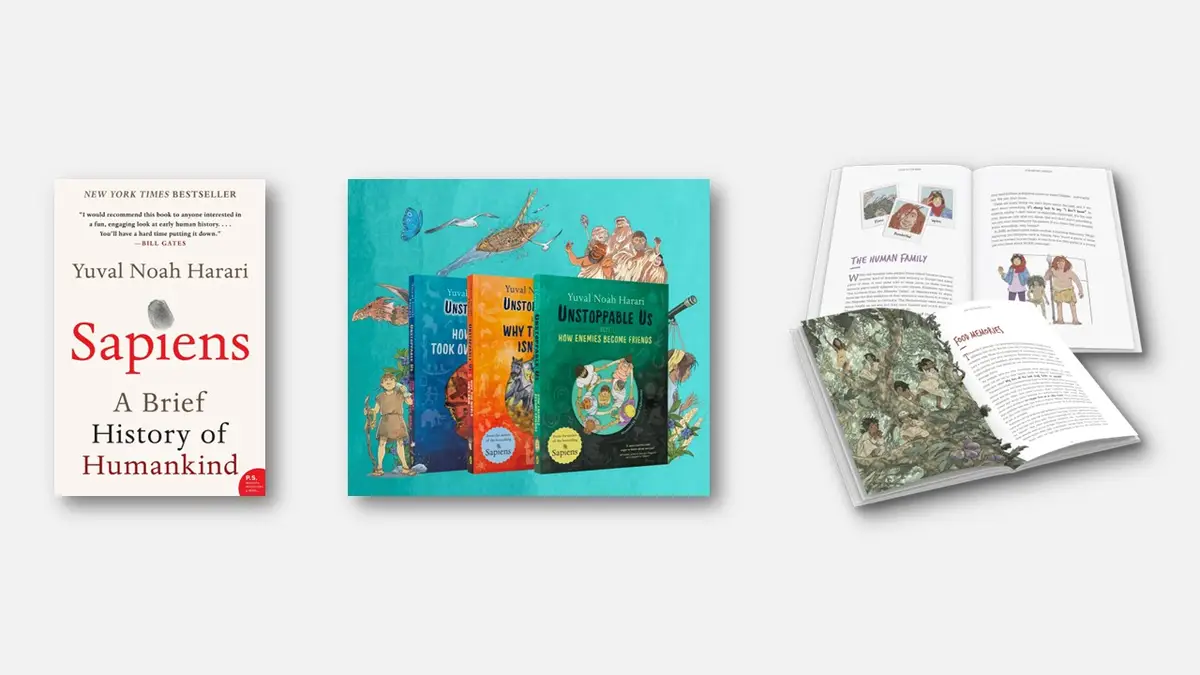
I read Sapiens years before I encountered Unstoppable Us. I instinctively linked the two, assuming that Sapiens served as the foundation for what Yuval Noah Harari later “rewrote” in Unstoppable Us, only this time for a younger audience. And yet, as I moved through Unstoppable Us, I found myself constantly comparing it to the narrative structure and argumentative framework that Harari had laid out in Sapiens.
However, my conclusion took me by surprise: Unstoppable Us left a far distinct, if not deeper, impression on me.
Reading Unstoppable Us felt like paying off a debt to myself, a debt I had neither acknowledged nor even realized I carried, or even knew existed.
Before religion, with all its arrogance and towering self-confidence, handed us ready-made answers about the universe, we were once curious and fiercely critical beings. We asked “why” and “how” about everything. We experimented, speculated, and searched for answers through whatever means we could find.
Then, we were introduced to the “Answers”: religious dogmas, social systems, and rigid structures of citizenship. These systems provided us with a pre-packaged reality. They offered neat, comforting packages that wrapped up every question. These answers weren’t always empirically or logically sound, but they were functional. They kept the social order intact. So, quietly and gradually, we buried that curious child inside us.
Without realizing it, we stepped out into adulthood as people who believed we already knew everything: who we are, where we came from, and how the universe works. Until, inevitably, we hit a wall where that pseudo-science was no longer enough.
That is the exact moment Unstoppable Us found me.
Harari did not simply simplify Sapiens for children. He stripped away the academic armor and spoke directly to the buried child in every adult reader. He reminded us that the story of humanity is not a finished textbook; it is an unfinished question. Suddenly the old questions—Where did we really come from? Why do we believe what we believe? What stories are we still telling ourselves that no longer serve us?—felt urgent again.
Reading the book was not an intellectual exercise. It was an emotional homecoming. It was the sound of the curious, skeptical, wide-eyed version of myself knocking from the inside, asking to be let out.
And perhaps that is Harari’s quiet genius: he understood that the most powerful way to reach adults is sometimes to speak first to the children they once were. Because the child never really left. It was only waiting for permission to be curious again.
So here I am, older, supposedly wiser, and yet, thanks to a book written for young readers, feeling younger and more alive than I have in a long time. The debt is paid. The curious self is awake. And the questions, after all these years, are finally mine again.